
In this episode of the Gallery Girl podcast we are joined by Afraa Ahmed, a Yemeni artist currently based in Cairo. Throughout her art Afraa explores the constructed landscapes of Yemen. Her work harnesses her experience as an expatriate exploring notions of place, belonging, identity and exile. Her recent work focuses on the spectrum regarding where the meaning of home falls into, in between imagination and reality, in between memory and intention.

Much of Afraa’s work centres around the qamariya, a Yemeni architectural motif that resembles a crescent moon, qamar being the Arabic word for moon. This motif is a type of window that is located on top of most Yemeni homes, fabricated from gypsum and stained glass, radiating colourful shapes when the sun hits it. “In my work I use it as a metaphor for home”, explains Afraa, “The way I see and experience the notion of belonging and what does it mean to be home or not.”
Afraa grew up in Yemen, but she moved to Malaysia to study, where she created her first iteration of the qamariya in 2018. “When I was there the conflict and war worsened in my country and in 2018 I started making qamariya as a way to react to what was happening”, she explains, later in 2020, she worked together with Arsheef Gallery in Sana’a Yemen, to create a broken qamariya installation in a show called When the Moon fell from the Sky it Broke. “It was a way to create a picture of what I was imagining in my country from afar”, she explains, “My memory of home was fragmented and to create a piece where it has broken pieces pictured what’s going on in my mind.” She says that people asked whether it was broken by accident, but that she is interested that each time she exhibits it, the qamariya will look different as the breaking will keep it different every time. “That’s the magic of installation”, she says, “Every time it’s different and that surprising element is vital for me. I feed on that.” She goes on to say that the work allows her to “…admit that even if it’s broken, it’s still the most favourite place to go or to be, or even to yearn for.”
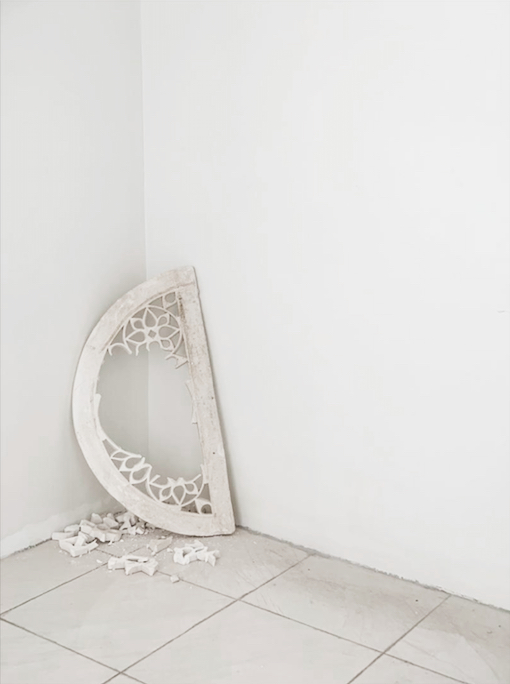
So far, Afraa’s qamariya have been made without glass. “It defers to the qamariya in my homeland due to the location and time I am at”, she says, “For example, for my first qamariya in Malaysia, I didn’t have enough materials or knowledge to create a qamariya, so I came up with my own technique. Mine will always be different and that’s important to highlight.” These qamariya act as witnesses to her journey from home. The traditional qamariya conversely, are made by artisans inherited by teachers, passed down from generation to generation.
Of her time in Malaysia, Afraa explains that the minimalism in her work is influenced by the Asian environment. “It’s so quiet there”, she says, “I feel like I was lucky to stay there for so many years, although that was not planned.” That said, she is excited to now be based in Cairo. “Being in Cairo after almost nine years away from the Middle East, I am just happy to be where people speak Arabic”, she says, “Here I can find people who use gypsum in a way that is similar to how artisans in Yemen make qamariya.” She will be exhibiting in Cairo soon, at the Citadel of Salahdin in November
Recently, Afraa returned to Yemen after a long time. “I felt like it’s time and when I went back I went through a series of ups and downs emotionally, but it was a vital trip”, she explains, “Reuniting with your family and friends, and being in your old room for example, holds so much to it.” While home, Afraa also worked on her artistic practice. She took her camera everywhere, saving moments from her journey. “I felt like I wanted to document this trip because it taught me so much and brought up so many questions of being home after so long”, she explains, “I worked towards a new project, a video that speaks about this experience.” This film will be supported by the Arab Fund for Arts and Culture, and she’ll be working with Asim Aziz.
Currently, Afraa is creating an installation for a biennale in Cairo that is an expansion – an Egyptian version – of her Bint al Qamariya series which she began in Malaysia. The work sees Afraa perform with the qamariya, taking it outside of the studio and going outdoors with it. “The qamariya and I become one creature in this temporary home”, she explains “It invites people into this new world of longing to a home and making a piece that gathers all elements, that starts with myself, a piece of home which is the qamariya, and the new home which is the land I stay in.”
So, besides identity and home, what inspires Afraa? “What happens everyday and the journey throughout time”, she says, “That’s the base of my work. That’s what inspires me, to know where I am at mentally and physically.”
You can follow Afraa on Instagram here
 gallerygirl.co